How many colors does a capsule need?
A capsule wardrobe is a small, deliberate set of clothes where the pieces combine freely. Capsules are often described as somewhere between 25 and 40 pieces, but the exact number matters less than how well they combine, and that is mostly a question of color.
A common working structure is four or five colors:
- two neutrals, one darker and one lighter
- one main color
- one or two accent colors
With fewer than four, a capsule can start to look like a uniform, which is fine if that is what you want. With more than five, combinations break down quickly, because each extra color has to work with everything else.
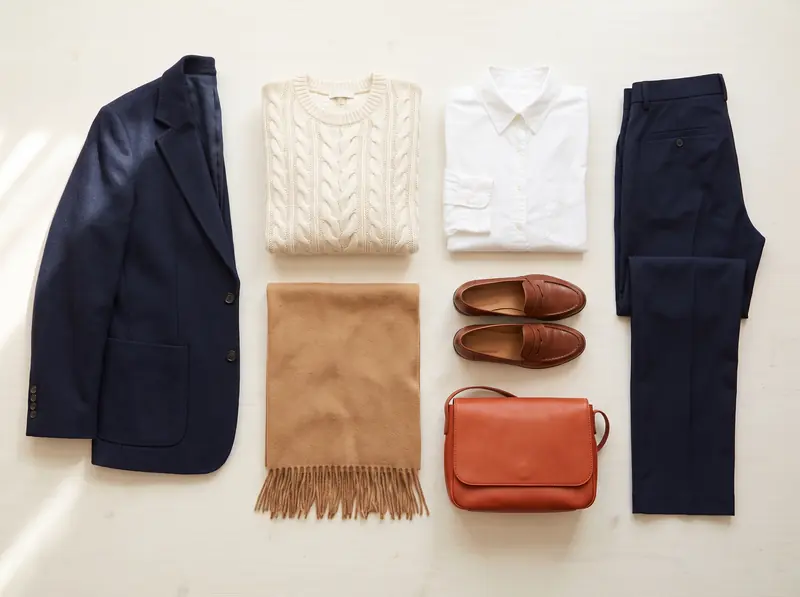
Why fewer colors give you more outfits
The arithmetic is simple. Say you have 4 bottoms and 8 tops. If all four bottoms are in your two neutrals, and every top works with both neutrals, every top goes with every bottom: 4 × 8 = 32 combinations.
Now make two of those bottoms a color that only works with half of the tops. You get 2 × 8 plus 2 × 4, which is 24 combinations from the same number of pieces. The capsule did not get smaller; it got less flexible.
That is why neutrals do the heavy lifting in a capsule, and why bottoms, outerwear and shoes are usually the first pieces to keep neutral.
The split: how much of each color
A rule of thumb that works for most capsules is to let the neutrals cover roughly two thirds of the pieces. The palette builder uses these shares:
| Color | 4-color capsule | 5-color capsule |
|---|---|---|
| Base neutral | 35% | 35% |
| Light neutral | 30% | 30% |
| Main color | 25% | 20% |
| Accent | 10% | 10% |
| Second accent | – | 5% |
In a 30-piece capsule, that is roughly 10 pieces in the base neutral, 9 in the light neutral, 6 to 8 in the main color and 3 to 4 in accents. Treat the numbers as a guide, not a quota: a capsule for a warm climate might lean further toward the light neutral, a capsule for an office toward the base.
Five capsule palettes that work
Each of these passes the builder's rules: one dark and one light neutral, no two colors too close to tell apart, no more than two loud colors, and no clashing undertones between neighboring hues. Open any of them in the builder to see it on garments, then lock what you like and shuffle the rest.
Navy, ivory, rust
Navy and ivory are about as safe as neutrals get. Rust warms them up, teal sits across the color wheel from rust as a small complementary accent, and mustard is a quieter second accent that sits close to rust.
Charcoal and dusty rose
A tonal capsule: every color comes from the same pink-to-wine family at different depths. It reads quiet and grown-up, and it is hard to get wrong because the accents can't clash with the main color.
Olive and rust
Warm and earthy. Olive works as a base neutral much like navy does, ecru keeps it light, and a deep petrol blue keeps the rust from turning the whole capsule orange.
Black, white and one red
The minimal capsule: black and optic white do almost everything, powder blue softens the shirts and knitwear, and a true red appears in one bag, one lipstick-red knit or a pair of shoes.
Soft navy and peach
A lighter, warmer capsule for people who find black and navy too heavy. Soft navy keeps some depth, peach is the main color, and aqua and coral are the accents.
Which piece gets which color
Once the palette is set, assign colors by how often a piece is worn and how expensive it is to replace:
- Base neutral: coat, trousers or jeans, shoes, the everyday bag. These are worn with everything, so they need to go with everything.
- Light neutral: shirts, tees, a light knit, and in summer a pair of trousers or a skirt.
- Main color: knitwear, a skirt or dress, maybe a jacket. This is where the capsule gets its personality.
- Accents: a bag, a scarf, one or two tops, a print that combines your main color and accent.
The garment preview in the builder follows this logic by default. Tap any piece to try it in a different palette color and see how the balance shifts.
For the order of decisions, from neutrals to accents, see how to build a color palette for your wardrobe. For choosing the neutrals themselves, see neutral colors for your wardrobe.
See the colors on you, not on a hanger
Upload a photo of yourself and a photo or shop link of a garment; FitInView shows you wearing it.
Your first try-on is included with a free account. No card needed. Your photos are private to your account.
Questions
- Does a capsule wardrobe have to be neutral?
- No. It needs a structure, not beige. The main color and accents can be as bright as you like, as long as the neutrals carry the pieces you wear most.
- Can I have different capsules for summer and winter?
- Yes, and it is common to keep the base neutral and change the light neutral, main color or accents with the season.
- Is denim a neutral?
- Mid-blue denim behaves like a neutral for most people, because it goes with almost every color. If you wear a lot of jeans, count them with your base neutral.